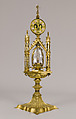
圣伊里耶半身圣骨盒
Artwork Details
- 标题: 圣伊里耶半身圣骨盒
- 创作日期: 约1220–40年
- 地域: 来自里蒙日附近的圣伊里耶-拉佩尔什教堂
- 文化: 法国
- 材料: 银,银鎏金,水晶石,宝石,玻璃
- 尺寸: 15 x 91⁄4 x 101⁄4 英寸(38.1 x 23.4 x 26.1厘米)
- 来源信息: J·皮尔蓬·摩根捐赠,1917年
- 藏品编号: 17.190.352a, b
- Curatorial Department: Medieval Art and The Cloisters
Audio
3125. Reliquary Bust of Saint Yrieix
NARRATOR: Barbara Drake Boehm is a curator at the Museum.
BARBARA DRAKE BOEHM: This is the reliquary bust of Saint Yriex, a saint who is venerated in Central France in a little village that bears his name. Saint Yriex was a nobleman of the sixth century. He lived to an old age. He was not martyred and upon his death he left all of his possessions and his property …to this monastery. Now there in the thirteenth century they made this reliquary head.
If you were to go to the village now, you would see in fact a copy of this reliquary head. They have a copy there that has the original skull of St. Yriex that is the prized possession of the church. The reliquary bust in a sense functioned as a kind of spiritual ancestor for the community and would’ve played a very active role in the life of the monastery. On normal days, it would’ve been displayed on the altar of the monastery’s church. But on the Feast of Saint Yriex and other important occasions it would’ve been processed through the village of Saint Yriex, as it still is today.
You can see wonderful details that have been worked into this silver head by looking at the gilt eyebrows of this saint and his kind of five o’ clock shadow. And then he has a wonderful collar, and it’s done in a technique, which is called filigree, where tiny little wires of gilt silver are turned and twisted around in rather complicated floral patterns as a background then to large rock crystals that decorate his collar, and then angels put on either side.
At the top of his head, you see a kind of hinged door and that was a means of providing access to the relic itself, that is, the skull of the saint.
NARRATOR: To hear about how this reliquary was made, walk to the wooden core on the other side of the case. [PAUSE]
BARBARA DRAKE BOEHM: What we did was to take those sheets off and to mount them on another modern core so that you could see both pieces together and really get a sense of the sculptural quality of this piece, which is more than just goldsmiths’ work. It’s also Gothic sculpture.
More Artwork
Related Content

Research Resources
The Met provides unparalleled resources for research and welcomes an international community of students and scholars. The Met's Open Access API is where creators and researchers can connect to the The Met collection. Open Access data and public domain images are available for unrestricted commercial and noncommercial use without permission or fee.
To request images under copyright and other restrictions, please use this Image Request form.
Feedback
We continue to research and examine historical and cultural context for objects in The Met collection. If you have comments or questions about this object record, please contact us using the form below. The Museum looks forward to receiving your comments.
Content Notice
The Metropolitan Museum of Art presents over 5,000 years of art from around the world, and our online collection reflects ongoing work conducted over the course of our more than 150-year history. You may encounter objects or images that may be inappropriate for some viewers or information that may be outdated.