Sphinx von Hatschepsut
Artwork Details
- Titel: Sphinx von Hatschepsut
- Zeitraum: Neues Reich, 18. Dynastie, gemeinsame Regierungszeit Hatschepsuts und Thutmosis' III.
- Datum: ca. 1473–1458 v. Chr.
- Geografie: Theben, Deir el-Bahri, Senenmut-Steinbruch
- Medium: Granit, Farbe
- Dimensionen: H: 164 cm, L. 3,43 m
- Anerkennung: Rogers Fund, 1931
- Akzession Nr.: 31.3.166
- Curatorial Department: Egyptian Art
Audio
3273. Sphinx of Hatshepsut
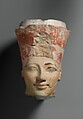
This colossal sphinx depicts a female pharaoh, Hatshepsut, who ruled from 1479 to 1458 B.C. She wasn’t the only female pharaoh, but she was one of the most important ones. Here, she’s shown wearing the ceremonial false beard – which all pharaohs wore, male and female. She also has the distinctive royal nemes head cloth.
Move around the body, and you’ll notice how the sculptor has carefully observed the powerful muscles of the lion’s sides and legs. Its posture is that of a guardian: calm yet attentive – and with paws planted, ready to leap up and pounce on an enemy. Look for the animal’s tail, elegantly wrapped around a hind leg. This is not a lion’s tail; but that of a bull. A bull’s tail was worn as part of the pharaoh’s royal costume, representing his power to bring forth life.
The remains of six granite sphinxes representing Hatshepsut were excavated in the late 1920s, by curators and archaeologists from The Metropolitan Museum. They found them broken into pieces, in a quarry close to Hatshepsut’s mortuary temple. Hatshepsut’s co-ruler, and eventual successor was Thutmose the Third. Late in his reign and about twenty years after Hatshepsut’s death, he had ordered that all the statues from her temple be removed and smashed. The reconstruction of this sphinx and of many other statues from thousands of excavated fragments was a major achievement of twentieth century archaeology. The filled-in areas on this statue are pieces that were never found. There is an entire room filled with reconstructed Hatshepsut statues. It’s gallery number twelve.
Listen to more about this artwork
More Artwork
Related Content

Research Resources
The Met provides unparalleled resources for research and welcomes an international community of students and scholars. The Met's Open Access API is where creators and researchers can connect to the The Met collection. Open Access data and public domain images are available for unrestricted commercial and noncommercial use without permission or fee.
To request images under copyright and other restrictions, please use this Image Request form.
Feedback
We continue to research and examine historical and cultural context for objects in The Met collection. If you have comments or questions about this object record, please contact us using the form below. The Museum looks forward to receiving your comments.
Content Notice
The Metropolitan Museum of Art presents over 5,000 years of art from around the world, and our online collection reflects ongoing work conducted over the course of our more than 150-year history. You may encounter objects or images that may be inappropriate for some viewers or information that may be outdated.