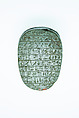
Heart Scarab of Hatnefer
Heart scarabs were very popular amulets. For the ancient Egyptians the heart was not only the center of life, but also of thinking, memory, and moral values. In the final judgement the heart was thought to be weighed against maat – the principle of order and justice. Only if the deceased had lived a righteous life was he or she allowed to live on in the afterlife. Understandably, the Egyptians feared a negative outcome and special amulets were used to ensure a positive judgment. The flat underside of a heart scarab is usually inscribed with chapter 30B of the Book of the Dead, the so-called heart scarab spell, or with its less common version, chapter 30A, which was used here.
The tomb of Hatnefer was discovered by the Museum's Egyptian Expedition in 1936. Hatnefer's heart scarab, mummy mask, canopic box, two rings, and two scarabs came to the Museum in the division of finds.
Artwork Details
- Title: Heart Scarab of Hatnefer
- Period: New Kingdom
- Dynasty: Dynasty 18, early
- Reign: reign of Thutmose II–Early Joint reign
- Date: ca. 1491–1473 BCE
- Geography: From Egypt, Upper Egypt, Thebes, Sheikh Abd el-Qurna, Tomb of Hatnefer and Ramose (below TT 71), Mummy of Hatnefer, MMA excavations, 1935–36
- Medium: Serpentinite, gold
- Dimensions: Scarab: L. 6.6 cm (2 5/8 in.); W. 5.3 cm (2 1/16 in.); H. 2.8 cm (1 1/8 in.); Chain: L. 77.5 cm (30.1/2 in.)
- Credit Line: Rogers Fund, 1936
- Object Number: 36.3.2
- Curatorial Department: Egyptian Art
More Artwork
Related Content
Perspectives
Articles, audio, and video from The Met's online magazine.
 VideoVideo
Connections: Bugs
Timeline of Art History
Entries and chronologies from The Met's art encyclopedia.

Publications
Books, guides, and catalogues published by The Met.
 Free to download
- Free to download
- Free to download
- Free to download
Research Resources
The Met provides unparalleled resources for research and welcomes an international community of students and scholars. The Met's Open Access API is where creators and researchers can connect to the The Met collection. Open Access data and public domain images are available for unrestricted commercial and noncommercial use without permission or fee.
To request images under copyright and other restrictions, please use this Image Request form.
Feedback
We continue to research and examine historical and cultural context for objects in The Met collection. If you have comments or questions about this object record, please contact us using the form below. The Museum looks forward to receiving your comments.
Content Notice
The Metropolitan Museum of Art presents over 5,000 years of art from around the world, and our online collection reflects ongoing work conducted over the course of our more than 150-year history. You may encounter objects or images that may be inappropriate for some viewers or information that may be outdated.