Двуручная чаша
Artwork Details
- Название: Двуручная чаша
- Художник: Корнелиус Кирштеде, США, 1674–около 1757 гг.
- Дата: 1700–1710 гг.
- Материал: Серебро
- Размер: 13,7 x 35,1 см
- Благодарность: Фонд Сэмюэля Д. Ли, 1938
- Номер объекта: 38.63
- Curatorial Department: The American Wing
Audio
4516. Two-handled Bowl
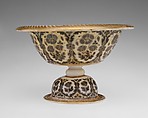
BETH WEES: This two-handled bowl, which is marked by the eighteenth-century silversmith, Cornelius Kierstede, an American silversmith of Dutch descent, is, I have to admit, one of my favorite objects in the collection. It is a masterpiece of our colonial silver.
MORRISON HECKSCHER: Beth Wees, curator of American Decorative Arts here at the Met.
BETH WEES: And what's particularly interesting about this bowl to the first-time viewer are the beautiful flowers which ornament each of the six panels of the bowl.
MORRISON HECKSCHER: They’re all different and represent Dutch flowers – tulips for instance. The elegant handles form a C-curve and are called caryatid handles. The bowl dates from about 1700-1710. Around this time silversmiths of Dutch and English descent were beginning to inspire each others’ designs.
BETH WEES: So that we have a bowl of . . . great Dutch influence in the shape of the bowl, in the flowers, but, also, English silversmithing techniques in the cast caryatid handles and in the little rimmed foot.
MORRISON HECKSCHER: Its usage is also Dutch. Called a brandywine bowl, it was filled with raisins and brandy and used on ceremonial occasions. Guests would pass the bowl around, scooping up raisins with a silver spoon.
BETH WEES: It was particularly used at an event called the kindermaal, where neighborhood women would gather to welcome a newborn child, which I think is a lovely custom.
More Artwork
Related Content

Research Resources
The Met provides unparalleled resources for research and welcomes an international community of students and scholars. The Met's Open Access API is where creators and researchers can connect to the The Met collection. Open Access data and public domain images are available for unrestricted commercial and noncommercial use without permission or fee.
To request images under copyright and other restrictions, please use this Image Request form.
Feedback
We continue to research and examine historical and cultural context for objects in The Met collection. If you have comments or questions about this object record, please contact us using the form below. The Museum looks forward to receiving your comments.
Content Notice
The Metropolitan Museum of Art presents over 5,000 years of art from around the world, and our online collection reflects ongoing work conducted over the course of our more than 150-year history. You may encounter objects or images that may be inappropriate for some viewers or information that may be outdated.