Prestige Panel
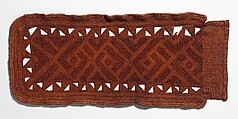
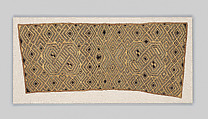
The medium of this amazingly diverse corpus of textiles is the fiber obtained from the raffia-palm leaf, which is transformed through intensive human labor, technical skill, and creative imagination. Although distinct both geographically and chronologically, the kingdoms of the Kongo and Kuba, renowned for the excellence of their textiles, are related through their use of similar techniques of adornment. Historically the product of such labors has been worn as finery by individuals of high social rank and distributed as units of wealth and currency. As precious familial property, such works have been used in dowry payments agreed upon in marital contracts and are lavishly displayed as funerary shrouds that reflect the affluence and importance of both the deceased and his or her extended family.
An important mandate of regional leaders has been to commission innovative works and design motifs emblematic of their individual legacies. In the seventeenth century, the founder of the Kuba dynasty of leadership identified so closely with the patronage and promotion of lavish woven and embroidered textiles that he adopted the term for raffia palm, shyaam, as a name and metaphor for his reign as "Shyaam the Great."
Artwork Details
- Title: Prestige Panel
- Date: 19th–20th century
- Geography: Democratic Republic of the Congo, Kasai River region
- Culture: Kuba peoples, Shoowa group
- Medium: Raffia palm fiber
- Dimensions: H. 2 1/2 x W. 23 in. (62.2 x 58.4 cm)
- Classification: Textiles-Woven
- Credit Line: Gift of William B. Goldstein, 1999
- Object Number: 1999.522.6
- Curatorial Department: The Michael C. Rockefeller Wing
More Artwork
Research Resources
The Met provides unparalleled resources for research and welcomes an international community of students and scholars. The Met's Open Access API is where creators and researchers can connect to the The Met collection. Open Access data and public domain images are available for unrestricted commercial and noncommercial use without permission or fee.
To request images under copyright and other restrictions, please use this Image Request form.
Feedback
We continue to research and examine historical and cultural context for objects in The Met collection. If you have comments or questions about this object record, please contact us using the form below. The Museum looks forward to receiving your comments.
Content Notice
The Metropolitan Museum of Art presents over 5,000 years of art from around the world, and our online collection reflects ongoing work conducted over the course of our more than 150-year history. You may encounter objects or images that may be inappropriate for some viewers or information that may be outdated.