Self-Portrait with Two Pupils, Marie Gabrielle Capet (1761–1818) and Marie Marguerite Carraux de Rosemond (1765–1788)
Labille-Guiard’s self-portrait with her students Marie Gabrielle Capet and Marguerite Carreaux de Rosemond is one of the most remarkable images of women’s art education in early modern Europe. In 1783 when Labille-Guiard and Elisabeth Louise Vigée Le Brun were admitted to the French Royal Academy, the number of women artists eligible for membership was limited to four. This canvas, shown with great success at the Salon of 1785, has been interpreted as a means of advocating their cause. As in most eighteenth-century artists’ self-portraits, Labille-Guiard depicted herself in impractically elegant clothing. Primarily a portraitist, she had especially faithful patrons in Louis XV’s daughters, known as Mesdames de France.
Artwork Details
- Title: Self-Portrait with Two Pupils, Marie Gabrielle Capet (1761–1818) and Marie Marguerite Carraux de Rosemond (1765–1788)
- Artist: Adélaïde Labille-Guiard (French, Paris 1749–1803 Paris)
- Date: 1785
- Medium: Oil on canvas
- Dimensions: 83 x 59 1/2 in. (210.8 x 151.1 cm)
- Classification: Paintings
- Credit Line: Gift of Julia A. Berwind, 1953
- Object Number: 53.225.5
- Curatorial Department: European Paintings
Audio
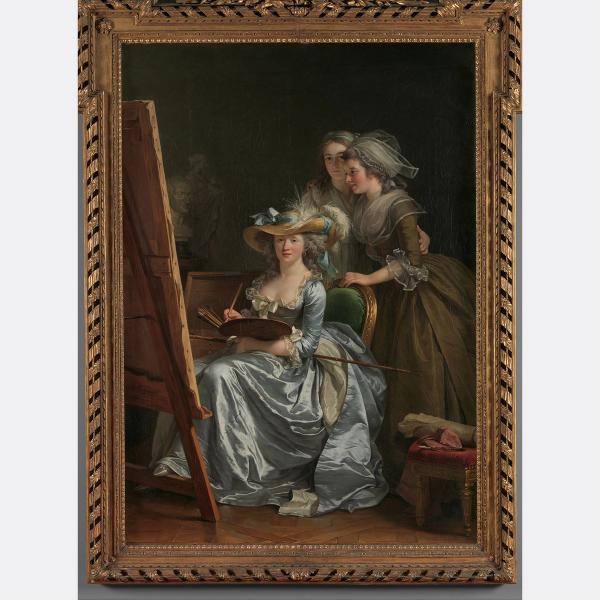
5019. Self-Portrait with Two Pupils
Labille-Guiard, 1785
KATHY GALITZ: She is showing herself as an artist at the top of her game. The idea that a woman artist painted this in the 1780s at a time when it was extraordinarily difficult for women to get recognized as professional artists…I admire the boldness and the assertiveness of her vision.
Hi. I’m Kathy Galitz and I’m an art historian and educator at the Museum.
In the 18th century, women of a certain social class like Labille-Guiard were expected, oh, if they wanted to do art, it was like a little hobby. You know, it shouldn’t be a professional pursuit. And it was even frowned upon for women to exhibit their art publicly.
NARRATOR: But Labille-Guiard not only presents herself as a professional, she showed this self-portrait at the 1785 Paris Salon.
KATHY GALITZ: She painted it big to be noticed.
LAURA HODGES: I do think it’s interesting that she is presenting herself in this very confident way.
Hi, my name is Laura Hodges, and I’m an interior designer.
NARRATOR: Like Labille-Guiard, Hodges is sensitive to the nuance of self-presentation as part of running her own business.
LAURA HODGES: I would imagine that she probably wouldn’t be dressed in such a formal gown (laughs)while she’s painting. I think it’s very interesting that she presented herself that way because it almost feels like she is balancing her role, and her place in society with her work.
NARRATOR: The choice to present herself in this elaborate silk gown was in fact a very strategic choice. A manifesto of sorts. Not only was she staking her claim as a woman in the Salon—which was at the time a decidedly male space—but her remarkable handling of the delicate lace and fabric showcase her technical prowess; you can see she even captures the reflection of her skirts in the polished floorboards.
LAURA HODGES: She is showing herself with pupils, to show the admiration that they have for her work and for her. There definitely seems to be a sense of passing down of her craft and her skill onto the next generation. I think she’s saying that it’s okay to be your own champion, and that women should champion each other and lift each other up.
Listen to more about this artwork
More Artwork
Related Content
Research Resources
The Met provides unparalleled resources for research and welcomes an international community of students and scholars. The Met's Open Access API is where creators and researchers can connect to the The Met collection. Open Access data and public domain images are available for unrestricted commercial and noncommercial use without permission or fee.
To request images under copyright and other restrictions, please use this Image Request form.
Feedback
We continue to research and examine historical and cultural context for objects in The Met collection. If you have comments or questions about this object record, please contact us using the form below. The Museum looks forward to receiving your comments.
Content Notice
The Metropolitan Museum of Art presents over 5,000 years of art from around the world, and our online collection reflects ongoing work conducted over the course of our more than 150-year history. You may encounter objects or images that may be inappropriate for some viewers or information that may be outdated.