Chiostro
Artwork Details
- Titolo: Chiostro
- Data: ca. 1130-40
- Area geografica: Proveniente dal monastero benedettino di Saint-Michel-de-Cuxa, nei pressi di Perpignan, Francia
- Cultura: Catalano
- Materiale e tecnica: Marmo
- Dimensioni: 27,4 x 23,8 m
- Crediti: The Cloisters Collection, 1925
- Numero d'inventario: 25.120.398–.954
- Curatorial Department: Medieval Art and The Cloisters
Audio
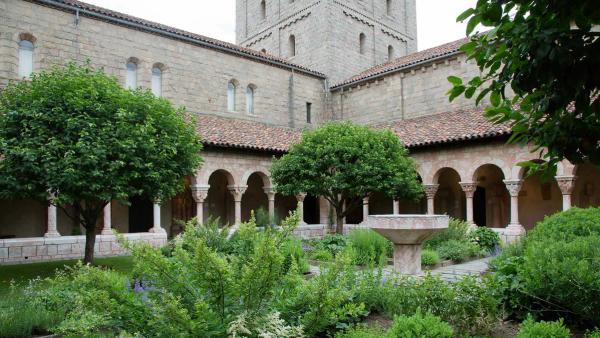
Cuxa Cloister
Gallery 7
NARRATOR: In this spot, you may feel like you’ve stepped back in time. Or that the middle ages have been brought back to life – in spring and summer, the garden beyond the columns is vibrant with flowers and the scent of lavender. Of course, this is just the effect that the founders of the Cloisters intended.
This is a cloister, an open courtyard, with covered walkways around the sides and a garden in the center. Every monastery had a structure like this, though there was considerable variety in size – the columns here actually come from a cloister nearly twice as large as this one. That cloister was built in the early twelfth century at a place called Cuxa in the Pyrenees Mountains, near the border between France and Spain.
Look at the capitals, or tops, of these columns. Some have clean and simple forms, but others have decoration that you may find surprising; you’ll see figures in antic, spread-legged poses, fantastic animals, and figures with human heads that end in snaky coils. *
These carved elements are all medieval, but the low wall beneath and some of the arches above are reconstructions - there are diagrams at the corners of the cloister to show you which is which. Elsewhere in the museum, it's easy to tell the difference, but here the stone is all the same. It has a distinctive color, a warm pink streaked with white, and it comes from a quarry near Cuxa. The quarry was reopened in the early twentieth century, and new stone was cut to make a full cloister for the medieval elements.
The cloister was the heart of every monastery; it connected the places where the monks or nuns carried out their daily routine. The Cuxa cloister fills a similar place here at the museum, connecting the gallery spaces on this level.
Listen to more about this artwork
More Artwork
![The Farnese Table, Jacopo [Giacomo] Barozzi da Vignola Italian, Marble of different colors, semiprecious stones, Egyptian alabaster, residue of paint of different colors on the piers, Italian, Rome](https://images.metmuseum.org/CRDImages/es/web-additional/DP-42913-001.jpg)
Related Content

Research Resources
The Met provides unparalleled resources for research and welcomes an international community of students and scholars. The Met's Open Access API is where creators and researchers can connect to the The Met collection. Open Access data and public domain images are available for unrestricted commercial and noncommercial use without permission or fee.
To request images under copyright and other restrictions, please use this Image Request form.
Feedback
We continue to research and examine historical and cultural context for objects in The Met collection. If you have comments or questions about this object record, please contact us using the form below. The Museum looks forward to receiving your comments.
Content Notice
The Metropolitan Museum of Art presents over 5,000 years of art from around the world, and our online collection reflects ongoing work conducted over the course of our more than 150-year history. You may encounter objects or images that may be inappropriate for some viewers or information that may be outdated.